
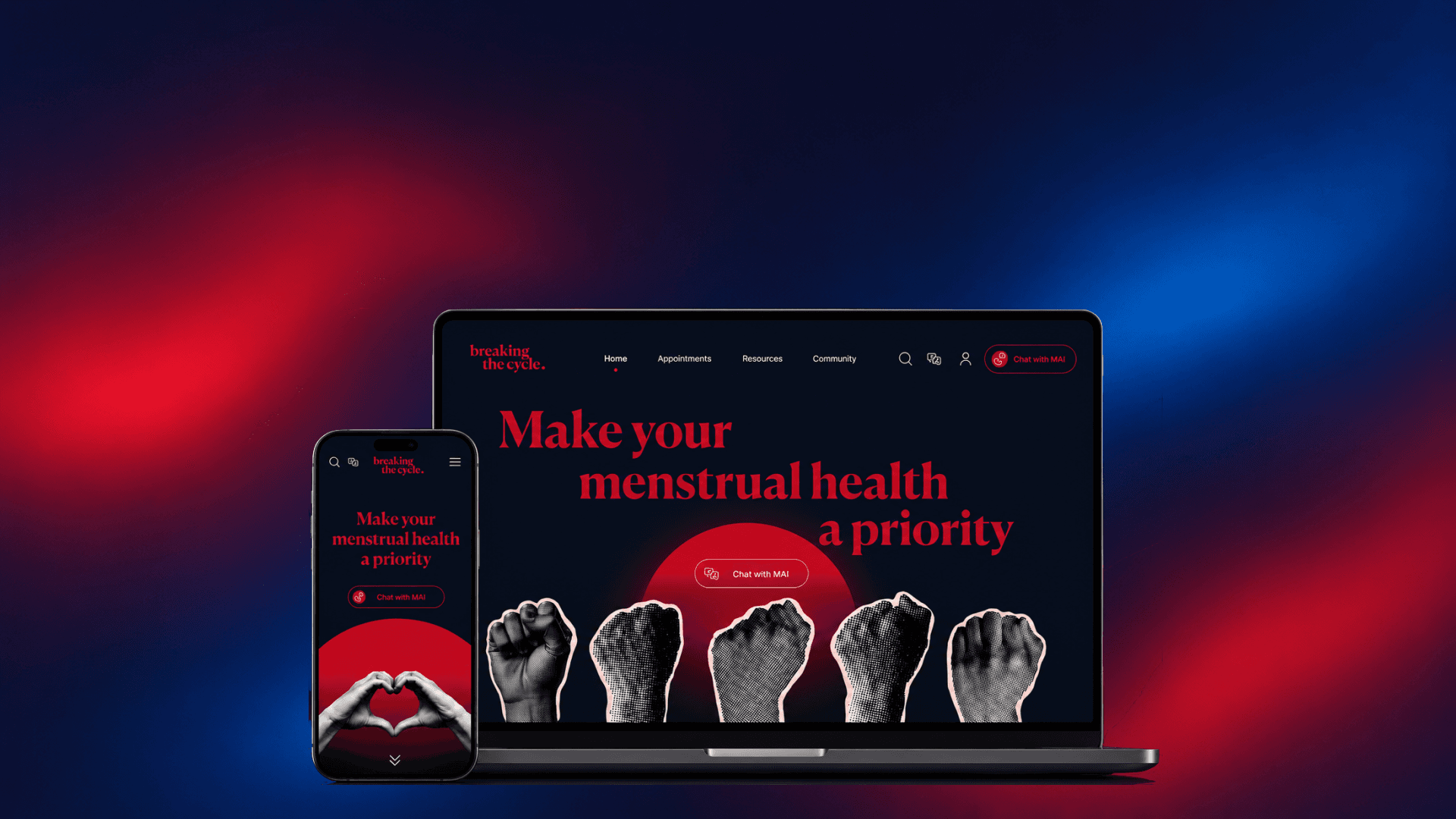
Breaking The Cycle
Designed culturally inclusive menstrual health pathways for international students navigating Australian healthcare, earning RMIT's Award for Social Innovation.
- Healthcare
- Service Design
- Systems Thinking
- Program & Year
- RMIT Master of DesignInnovation & Technology - 2024
- Role
- Service Designer,UX Researcher
- Scope
- UX Research, Service Design,Systems Thinking, UI/UX Design
Service
Breaking The Cycle is a community-centric service platform providing menstrual literacy, equity and advocacy for international students from diverse cultural backgrounds.
Challenge
International students faced a fragmented and unfamiliar healthcare system, with cultural stigma, limited health literacy and complex information creating barriers to accessing timely and appropriate care.
Solution
A culturally inclusive healthcare experience that brings together trusted information, peer-led support and personalised care pathways to help international students understand their options, navigate services and seek support with greater confidence.
Result
The concept was developed through research with international students and healthcare stakeholders, then tested with 15+ international students and 3 industry experts to validate the experience and refine the service.
Impact
15+
international students involved in testing
3
industry experts involved in evaluation
1
RMIT Award for Social Innovation

The question
A cycle worth breaking
How might we address stigma, lack of knowledge on menstrual health, and health system challenges for international students in Australia to promote menstrual literacy, equity and advocacy through a community-centric approach?
Background
Breaking the silence around periods
As part of my final semester for my Masters program, I worked on a service and experience design project chosen out of personal experience, driven by a need to start conversations around menstruation since it's still considered a taboo topic. The project took menstrual health issues within Australia into context for its scope.
Menstruation remains a taboo in many cultures, impacting equitable menstrual health access in Australia, especially among diverse cultural and gender groups. Given the significant cultural, social and economic contributions of international students to Australia, ensuring their equitable health access is crucial.
The Multicultural Centre for Women's Health (MCWH) advocates for innovative health education and advocacy: training healthcare staff, providing multilingual information and community engagement.
Design Approach
A human-centred, community-first method
The project employs a human-centred approach and service design methodologies through auto-ethnography and participatory methods via expert interviews and user involvement in the form of discussions and observations. It aims to promote FemTech, i.e. technology tailored to women's health.
Listening to the community
What students and health educators told me
After noting my own experiences and linking them to the socio-cultural context in Victoria, an Empathy Map seemed the best tool to get deeper insight. I also spoke with Amira from the Multicultural Centre for Women's Health, who facilitates outreach programs for migrant and refugee women.
My questions centred on how to bridge the gap between these organisations and international students. Amira explained that students need a platform where everything is in one place — the current process is scattered, and students often don't know where to go, especially when newly arrived in a country.
“We tackle the unsaid but assumed things that people can't share with the GPs”
“Some women have difficulty in understanding the system”
Amira Rahmanovic
Bilingual Health Educator, Multicultural Centre for Women's Health
“There's a gap between international students and women's health organisations to access their resources”
“We must change the story around the stigma associated to menstruation by talking about it”
“I prefer having an online platform especially with women's health since information is more accessible”
“I want to understand if my doctor's visit is included in my OSHC”
“I follow my friend's advice and check with other people about the process and go by word of mouth”
International Students
Perspectives shared through student conversations
“I have questions I want to ask to the doctor but I don't know what kind of questions I should ask”
“Our health system back home is very different so it took me a while to get used to the healthcare system here”
“I search for symptoms on Google and often get vague results and not relevant to me”
Mapping the system
Understanding who shapes this experience
It's important to analyse the stakeholders involved, as they have a direct or indirect impact on the people who menstruate. This map was built by analysing the level of interaction each stakeholder has with the student.
- Primary stakeholders — play a direct part in the student's life, educating and communicating with them
- Secondary stakeholders — have some direct and indirect impact on the student's decisions
- Tertiary stakeholders — have an indirect impact, mainly government bodies and policy makers
Behavioural insight
Beyond Demographics: Understanding our users
What the research revealed
These are some insights gained from self-ethnography as well as through informal conversations with people who have gone through the healthcare process:
- They're self-driven and want to take ownership of their well-being
- Their menstrual experiences are mostly associated with shame, considered something that cannot be talked about — they want to move away from this and be empowered with updated resources and information
- They're comfortable trusting someone who has had a shared experience and would most likely base their decisions around their suggestions
- They prefer to have the initial contact online for seeking information and asking health-related questions — some also prefer anonymity
“The Community Seeker”
Essence + Expression
- Culture is essential to their very being and how they explore the world
- They enjoy activities that help them connect with and share experiences with others — they are community minded
- They like to be sure that everyone is welcome to enjoy the benefits of engaging, and put a high price on inclusivity
- Source: Meet the Segments, Morris Hargreaves McIntyre
User Journey Map
Menstrual challenges faced by Community
In order to fully understand the pain points of the current healthcare system, a user journey map was created mapping out an international student's current experience with the Australian healthcare system when visiting the gynaecologist for the first time for a menstrual health concern.
Narrowing down the scope
Point of Intervention
Upon searching for a suitable point of intervention, the RMIT Health, Safety & Wellbeing Services page seemed like the best fit as it's the hub for all health and wellbeing services.
There was no other direct point of contact for health services specifically around reproductive or sexual health — the only way was to get an appointment with a GP through Medical Hub, with varied waiting times and not enough options to match the patient's needs.
From insight to feature
Turning research into a roadmap
Each key theme from the research — access to care, lack of knowledge, cultural and language barriers, and community support — surfaced a corresponding feature opportunity, from a custom AI chatbot to peer-to-peer workshops.


Introducing Breaking The Cycle
A platform built around three kinds of support
‘Breaking The Cycle’ is a community-centric platform focused on providing menstrual literacy, equity, and advocacy for international students from diverse backgrounds. The proposed design includes a communication campaign for a website featuring:
Tailored Care
- Culturally sensitive healthcare providers
- Need-specific discussion prompts
Resources
- An AI chatbot offering specific health information
- A database of evidence-based health resources
Community Engagement
- Peer support
- Health education workshops
Made to be more accessible, personal and equitable
The vision for ‘Breaking The Cycle’ is to enhance conversations about menstrual health, making women's healthcare more accessible, personalized, and equitable, especially among culturally and linguistically diverse people.
The framework
How the service comes together
1. Awareness
- Building awareness among international students who turn to their universities for health information
- Attempting to draw attention through an inclusive medium
2. Interaction
- A student experiencing extreme menstrual symptoms like heavy bleeding, extremely painful cramps, etc. sees these touchpoints
- They interact with the QR code to find out more because they are intrigued by the posters and menstrual product stations
3. Engagement
- Collaborative education workshops with the Multicultural Centre for Women's Health (MCWH)
- Topics could be covered through surveys and issues that students bring up with Menstrual Health Advocates
Visual identity
Designing a palette that feels human
Red symbolises the quest for societal transformation — and the obvious reasoning was also the colour of blood. Blue and orange were the original colours of the Women's Liberation Movement, an inspiration for the secondary palette representing empowerment through breaking stereotypes and changing the conversation around menstrual health.
Design Outcome
Bringing the service to life
The design outcome is a communication campaign for a website for international students, spanning the different touchpoints, components and features of the service — from awareness, to interaction, to ongoing engagement.
Awareness
Meeting students where they already are
Engaging international students through inclusive mediums of communication.
The number of international students studying in Victoria totalled 195,916 for the January–February 2024 period: China – 43,975, India – 43,665, Vietnam – 12,077 (Source: Department of Education, 2024).
The posters were designed keeping in mind the demographics, their cultural background and the languages they speak, in order to keep the tone inclusive of diverse backgrounds.
A station stocked for everyone
Another component of the ‘Awareness’ stage of the framework was a ‘Menstrual Care Station’. The idea for this stemmed from keeping the conversation inclusive of all genders as well.
The stations would naturally be a supply station of menstrual health products like pads, tampons, liners, etc. for people that menstruate.
This would be installed in women's toilets as essential supplies, but would also be available in common spaces outside toilets to be more gender neutral and provide access to these products to whoever may need them.
This is also a way to include men in the conversation, as they can keep the products handy for their friends and/or partners.
The menstrual care station would also have small zines for how men can support someone when they're on their period, prompting them to initiate conversations with women about how to be more open and empathetic about menstruation.
Interaction
A prototype students could actually try
Engagement
Workshops shaped by student questions
The health workshops would be conducted at RMIT University based on the questions or queries the students bring up with the Menstrual Health Advocates, which would further be deliberated upon through surveys among students.
Educational workshops
Understanding menstrual health issues like endometriosis and PCOS, the Australian healthcare system, and demonstrations of how to use products like menstrual cups and tampons.
Co-design workshops
Students, Menstrual Health Advocates and women's health organisations come together to co-design resources and features tailored to specific needs, with outputs implemented directly in the service.
Training workshops
For Menstrual Health Advocates, to build cultural sensitivity, ways to communicate respectfully with students, and more inclusive language.
Stakeholder Map for Breaking the Cycle
The following stakeholders would help to:
The stakeholders would form the Breaking the Cycle ecosystem through different students and student groups, healthcare staff, women's health organisations specialising in Culturally & Linguistically Diverse groups as well as gender diverse groups. Lastly, insurance providers would also play a key role, as the list of healthcare providers available for international students would come from the OSHC providers.
- Engage key stakeholders from the early stages of the project
- Secure needed resources
- Improve communication between direct and indirect stakeholders to get everyone on the same page
- Anticipate stakeholder questions, needs and concerns
Impact and Reflection
Feedback from the field

Amira Rahmanovic — Bilingual Health Educator, MCWH
“This would be very helpful for students but also for women's health organisations to create resources for international students' specific needs.”

Esther Xu — Bilingual Health Educator, Women's Health East
“Expanding this to other universities would be useful for students to help each other out.”

Juliet Wong Min — Product & UX Design Specialist, The Aquarium
“The website is easy to navigate and the features are very clear and easy to understand.”
Impact
Looking ahead
Future impact spans individual, community and organisational levels — from enhanced knowledge and a sense of support, through cultural exchange and expanding the service to other universities, to improved educational resources and visibility for the cause.
Reflection
A challenging, rewarding project
Breaking the Cycle challenged me to look beyond designing a solution and think more deeply about the cultural, systemic and human factors shaping people's experiences. Working closely with international students and healthcare professionals reinforced the importance of listening, questioning assumptions and designing with communities rather than simply for them. It remains one of the most meaningful projects I've worked on.
Team
Service & UX Designer
Abhishta Lalwani, solo capstone project
Project Mentors
Dr. Areli Avendano Franco & Prof. Jules Moloney
In partnership with
Multicultural Centre for Women's Health (MCWH)
Previous
← Guiding The ConversationNext
JioMotive →