
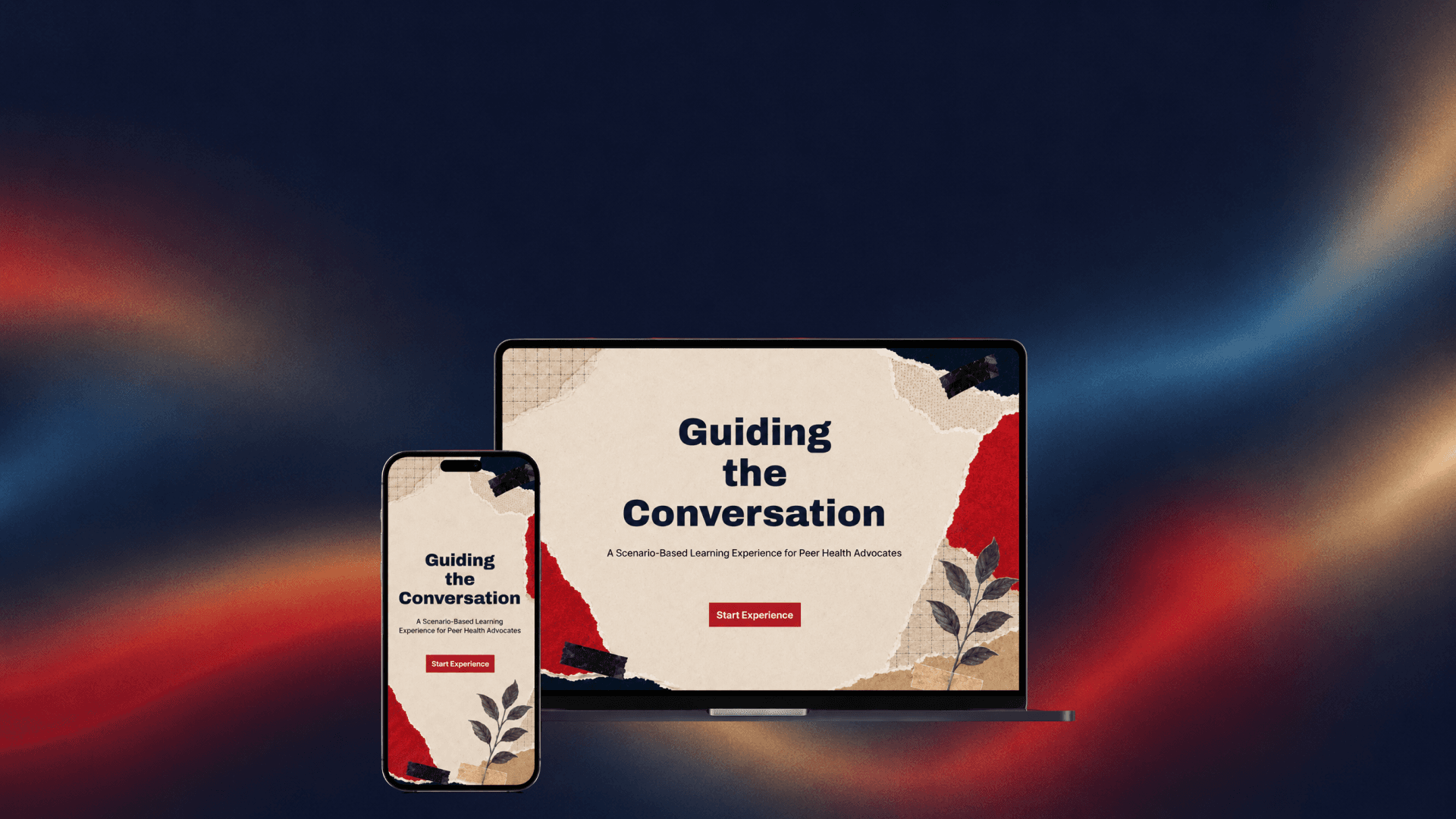
Guiding The Conversation
Designed a research-informed learning experience that equips Peer Health Advocates for culturally sensitive health conversations.
- Learning Experience Design
- Scenario-Based Learning
- Healthcare
- Years
- 2026
- Role
- Learning Experience Designer,UX Researcher
- Scope
- Learning Design, Scenario-Based Learning,UX Research, Interaction Design
Product
An interactive learning experience designed to help Peer Health Advocates confidently support international students navigating menstrual and reproductive health conversations in Australia.
Challenge
Peer Health Advocates are often an accessible first point of support, but navigating sensitive health conversations across different cultural contexts requires the confidence to listen without judgement, respond appropriately and guide students towards trusted care.
Solution
A scenario-based learning experience that places advocates in realistic conversations with diverse international students, allowing them to practise building trust, responding with confidence and guiding students towards appropriate healthcare pathways and support.
Result
Translated research from Breaking the Cycle into an applied learning experience, using realistic scenarios, decision-making and feedback to help Peer Health Advocates turn health knowledge into practical conversational skills.
Impact
15+
international student research participants
3
scenario-based learning modules
3
core capabilities developed

The question
A safer place to practise the hard conversations
How might we equip Peer Health Advocates with a safe, engaging way to practise culturally sensitive health conversations before supporting students in real life?
Background
Building on Breaking the Cycle
This project builds on insights from my Master's Service Design project, Breaking the Cycle, which explored the barriers international students face when accessing women's healthcare in Australia.
While Breaking the Cycle addressed access to trusted information and services through a digital platform for RMIT students, research identified an additional challenge: students often turned to peers before seeking professional healthcare, yet these peer supporters lacked structured preparation to confidently facilitate culturally responsive conversations while maintaining appropriate boundaries.
Rather than creating more informational resources, this project focuses on preparing Peer Health Advocates to become trusted first points of contact.
Discover
What we already knew
- International students face systemic barriers when accessing women's healthcare in Australia
- Breaking the Cycle provided access to information and resources
- A behavioural pattern found that students turned to peers for support and guidance
Discover
A conversation with Amira Rahmanovic, MCWH
Some key takeaways from my chat with Amira Rahmanovic from MCWH:
- “Some women have difficulty in understanding the system”
- “There's a gap between international students and women's health organisations to access their resources”
The insight that shaped everything
Peers are the first point of contact, yet these supporters lack structured preparation to confidently facilitate culturally responsive conversations while maintaining boundaries.
We don't need to build more informational resources. We need to build capable guides.
Discover
Where the intervention sits
Define
Who we're designing for
A closer look at who they are
While women's health organisations connect international students with healthcare professionals, a gap remains in how students access and understand these resources. Peer Health Advocates are a practical starting point, as they are trusted student leaders who provide first-hand guidance.
Based on the Culture Segments Motivation Model, they are community-minded, inclusive, and intrinsically motivated, making them an ideal target audience for this learning solution.
Profile
3rd year Health Sciences student, multidisciplinary volunteer (e.g. Nursing, Public Health, Psychology)
Motivation
Passionate about supporting international students and reducing barriers
Learning Preferences
Training, authentic practice, discussions, continuous feedback and reflection
Define
Where the gaps are
Define
So where exactly does the knowledge and skill gap begin?
Define
Proposed journey map
Define
Learning objectives and outcomes
Listen & Build Trust
Objective: Demonstrate active listening, use culturally responsive communication, create psychological safety.
Outcome: Builds rapport and facilitates supportive conversations.
Attitude required: Empathy & Cultural Humility.
Respond with Confidence
Objective: Recognise role boundaries, respond empathetically, analyse when referral is needed.
Outcome: Provides safe peer support while maintaining appropriate professional boundaries.
Attitude required: Accountability & Respect.
Guide to Care
Objective: Explain healthcare pathways and connect students to relevant services and resources.
Outcome: Confidently signposts students to appropriate healthcare.
Attitude required: Professional Responsibility.
Design
From storyboard to prototype
I developed a text-based storyboard to map the learner experience before prototyping. Three branching scenarios, each representing a different student context, were designed to help Peer Health Advocates practise the core behaviours identified during the needs analysis: building trust, responding empathetically within role boundaries, and guiding students to appropriate healthcare services.
The storyboard documented dialogue, learner choices, mentor feedback, and branching logic to ensure alignment between the learning objectives and the final learning experience.
Three branching scenarios
Design
A visual system built for trust
After finalising the storyboard, I designed a simple visual system that keeps the focus on the conversations rather than the interface.
I used plenty of white space, a clear layout and consistent interactions to reduce cognitive load and help learners concentrate on making decisions. The colour palette was inspired by women's health and university wellbeing services, using warm reds and neutral tones to create a sense of trust and safety.
To make the scenarios feel authentic, I placed learners in familiar campus environments with speech bubbles, character illustrations and a mentor that provides guidance when needed. Keeping the interface consistent throughout helps learners focus on practising real conversations instead of figuring out how to use the experience.
Development
Bringing it to life in ActivePresenter
With the storyboard finalised, I developed the learning experience in ActivePresenter, translating each scenario into an interactive prototype. Branching conversations, mentor feedback, knowledge checks and practical resources were integrated to create a realistic practice environment where learners could build confidence through decision-making and reflection.
Alongside the interactions, I designed a cohesive visual system, custom illustrations and interface components that reinforced the conversational tone of the experience while maintaining consistency, accessibility and ease of navigation throughout the course.
Evaluate
Measuring what matters
I applied the Kirkpatrick Model using a backward design approach (Levels 4–1) to ensure each learning objective aligned with the intended impact. Starting with the desired outcomes helped identify the behaviours, knowledge and skills learners needed before designing engaging learning experiences to support them. The methods shown outline how the effectiveness of the program could be evaluated if implemented.
Reflection
Designing for people, not just systems
This project challenged me to think differently about designing for learning. Coming from a Service Design background, my instinct is to improve systems and services. Through this project, I learned that instructional and learning design focuses on building people's knowledge, skills and confidence to create meaningful change within those systems.
One of my biggest takeaways was the importance of designing backwards. Rather than starting with content, I began with the behaviours and outcomes I wanted learners to demonstrate, which helped me create more purposeful learning objectives, scenarios and evaluation strategies.
I also gained hands-on experience designing a complete learning experience, from learner analysis and storyboarding to prototyping in ActivePresenter. Creating branching scenarios reinforced how authentic practice and feedback can be more effective than simply presenting information.
While this was a concept project, the research was based on my major project with real research conducted during that time, demonstrating how women's health organisations and students can collaborate effectively. This project showed me how my Service Design skills complement instructional design. User research, empathy, journey mapping and systems thinking provided a strong foundation for understanding learner needs and designing experiences that are both human-centred and outcome-focused.
Previous
← NorthStar