
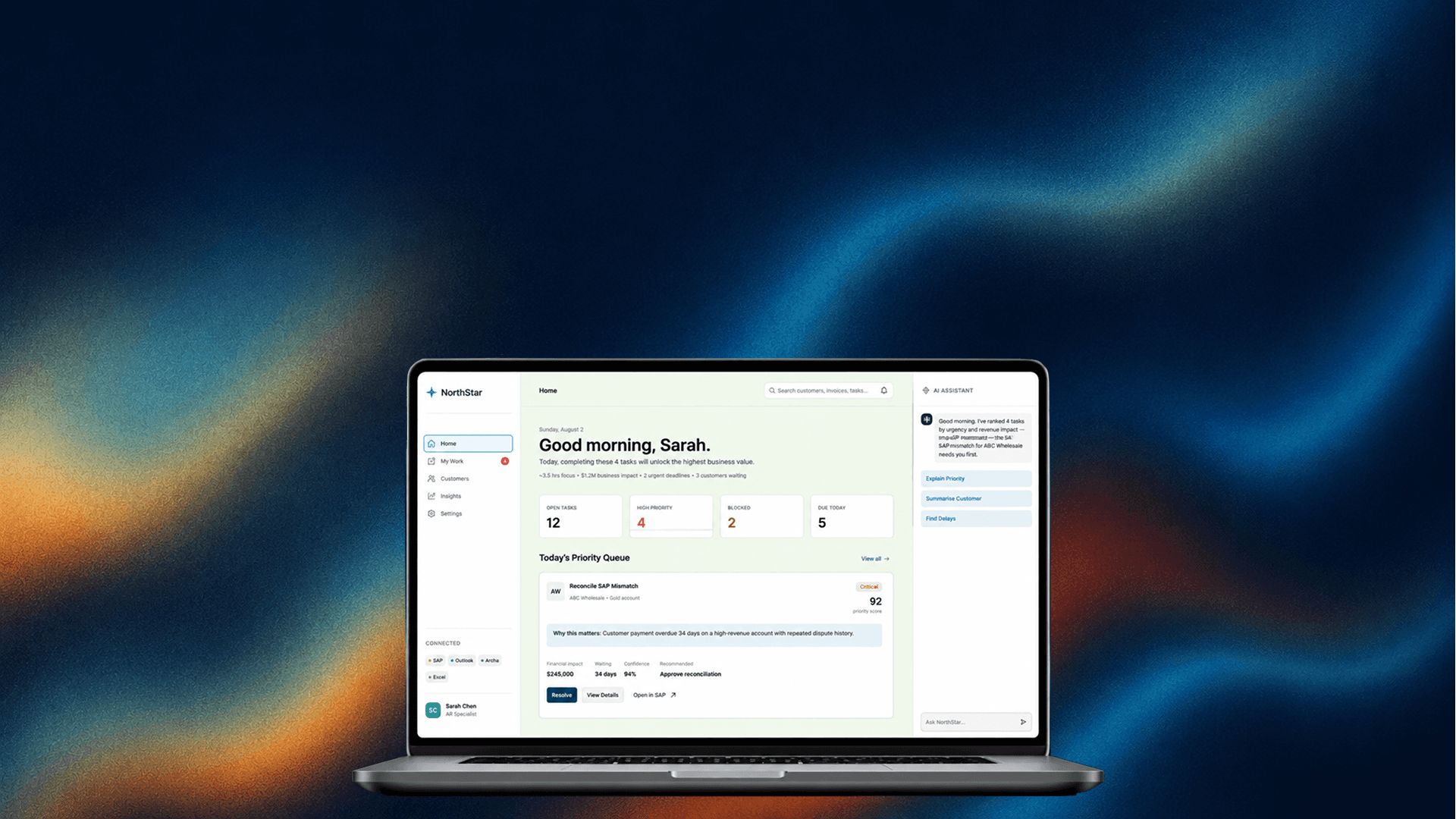

NorthStar
Aimed to reduce complexity by shifting from system-centric workflows to intelligent, task-first experiences.
- AI Experience Design
- Enterprise UX
- Product Design
- Years
- 2026
- Role
- Product Designer,UX Researcher
- Scope
- UX Research, AI Experience Design,Interaction Design, Design System
Product
An AI-enabled enterprise workspace that reimagines how Accounts Receivable teams prioritise, coordinate and complete work across connected business systems.
Challenge
Enterprise work is fragmented across SAP, Outlook, Excel, Teams and internal systems, forcing employees to constantly switch contexts, manually prioritise work and manage competing requests. This increases cognitive load, delays decision making and reduces productivity.
Solution
A unified AI-powered workspace that aggregates work from connected enterprise systems, automatically prioritises tasks based on business impact and urgency, and embeds contextual actions directly within existing workflows to reduce friction and improve focus.
Result
Explored how AI can transform enterprise work by shifting from system-centric workflows to an intelligent, task-first experience that proactively guides employees through their highest-impact work.
Impact
5+
connected enterprise experiences
4
integrated business systems
1
task-first AI workspace

The question
Reducing delay in accounts receivable work
How might we help Accounts Receivable teams reduce operational delays by making it easier to prioritise work, access context and take the right next action?
Background
Learning from Accounts Receivable operations at Coles
Inspired by my experience working in Accounts Receivable operations at the Coles Group, I explored how senior AR employees manage competing responsibilities across credit decisions, customer communication, account maintenance, invoicing and administrative work.
To better understand the operational landscape of Accounts Receivable, I began by mapping the people, responsibilities, systems and decisions involved in a typical workflow. Drawing on my experience in AR operations, this exercise helped identify how work is distributed across multiple platforms, where interruptions occur, and the business consequences of delayed tasks. These early observations formed the foundation for the problem space and guided the focus of the subsequent research.
Discover
Mapping the stakeholders
To better understand the broader Accounts Receivable ecosystem, I mapped the stakeholders involved in the credit assessment and account management process based on their level of influence and day to day involvement. Accounts Receivable Officers, Senior AR Officers and Team Leaders emerged as the primary stakeholders, as they are directly responsible for prioritising work, making credit decisions and managing operational performance. Finance Leadership, IT Leadership and System Owners hold greater strategic influence over policies and technology, while Customer Service, Collections, SAP Support and Business Customers rely on the efficiency of the AR process to complete their own work. This exercise helped identify whose needs the solution should prioritise and highlighted the importance of balancing operational efficiency with organisational goals.
Discover
The current workflow
Senior Accounts Receivable employees manage competing priorities across multiple systems, requiring them to constantly assess urgency, customer impact and financial value. This fragmented way of working creates an opportunity for a unified, data-informed approach to workload prioritisation.
Primary and secondary research revealed that AR teams spend a significant amount of time on manual administrative work rather than higher value decision making. Manual processes increase cognitive load and reduce efficiency. As Hilden (2022) notes, "The work burden is too much relative to the time given, the process lacks structure."
Research also found that much of the procedural knowledge required for AR work is shared informally, making onboarding slower and increasing reliance on experienced staff. Nikkola (2020) highlights that many recurring tasks lacked documented guidance despite following repeatable patterns.
Finally, employees are already comfortable using digital tools in their daily work. Kiiskinen (2024) found that automated customer reminders were viewed positively, suggesting that staff are receptive to automation when it reduces repetitive tasks. Combined with frequent meetings, customer calls and onboarding responsibilities, these findings highlight the need for a solution that reduces manual effort and helps employees focus on high value work.
Discover
Learning from existing solutions
I analysed a few competitors working in the same space as AR automation, productivity and planning.
HighRadius
What it does well: end-to-end AR automation, AI-powered collections, enterprise dashboards.
- Opportunity: Could better support day to day operational prioritisation across mixed responsibilities.
Microsoft Planner + Outlook
What it does well: organising tasks, calendar and email management, personal productivity.
- Opportunity: Lacks operational context, financial impact and intelligent prioritisation.
BlackLine
What it does well: enterprise finance workflows, financial governance, ERP integration.
- Opportunity: Focuses on finance processes rather than supporting operational attention management.
Where the opportunity sits
Existing AR platforms excel at automating financial workflows, while productivity tools help employees organise their work. However, neither fully addresses the challenge of helping Accounts Receivable teams understand where their attention is needed most across competing operational responsibilities.
This opportunity became the foundation for NorthStar.
Define
Identifying operational bottlenecks
To understand operational bottlenecks in Accounts Receivable, I combined reflections from my experience at Coles, discussions with colleagues, and secondary research.
- Dispute resolution has the longest waiting times
- Missing information creates unnecessary work
- Multiple ownership handoffs increase delays
- Employees spend significant time gathering customer context
- High value work is difficult to prioritise manually
Turning data into direction
As no public dataset exists for Coles' internal operations, I created an AI-assisted synthetic dataset of 1,200 work items across eight AR workflows. Based on real world processes and industry best practices, the dataset enabled realistic analysis without exposing confidential information.
Using SQL (DuckDB UI) with Claude assisting in query development, I analysed workflow patterns to translate data into insights, opportunities and NorthStar interventions.
Define
Dispute resolution experiences the longest waiting times
Data: Disputed invoices experience the longest delays due to multiple verification steps, approvals and ownership handoffs. Secondary research found that billing disputes averaged 10 days to resolve, reducing to 3 days after implementing automation (Resolve, 2026).
Insight: Dispute resolution takes significantly longer than other AR tasks because of fragmented ownership and information dependencies rather than processing effort.
Opportunity: Employees need a unified queue that highlights the most time-sensitive work across all systems.
NorthStar intervention
- AI Priority Queue
- Waiting Time Indicator
- Blocked Status
- Next Recommended Action
Define
Missing information creates unnecessary operational work
Data: Finance teams spend significant time searching for information, with 50% spending over 6 hours per week and 13% spending more than 10 hours locating data in documents (Hebbia, 2026).
Insight: Incomplete requests resulted in longer waiting times and significantly more follow-up emails, showing that validation happened too late in the process.
Opportunity: Validate requests before they enter the operational queue.
NorthStar intervention
- Completeness Checker
- Real-time Validation
- Submission Status
- Missing Information Guidance
Define
Multiple handoffs increase delay
Data: Cross-functional work averages four handoffs, with each transfer increasing the likelihood of delays by over 20% (Management Trends, 2026).
Insight: Every ownership transfer increased waiting time and reduced accountability.
Opportunity: Give employees clear visibility into ownership, transfers and dependencies.
NorthStar intervention
- Ownership Timeline
- Approval Tracker
- Team Dependency Indicators
- Current Owner Visibility
Define
Employees spend significant time reconstructing customer context
Data: Employees spend an average of 3.6 hours per day searching for information, with 60% using four or more systems daily to find what they need (Coveo Workplace Relevance Report, 2022).
Insight: Employees spent significant time searching for customer history, emails and previous decisions instead of completing work.
Opportunity: Customer context should travel with the work item, eliminating the need to search across systems.
NorthStar intervention
- Unified Customer Workspace
- AI-Generated Case Summary
- Cross-System Activity Timeline
- Related Email & Call History
Define
High value work is difficult to identify manually
Data: FIFO prioritisation often overlooks urgent or high value work. Research recommends using a weighted score based on urgency, business impact and customer value (Bhatia, 2022).
Insight: Waiting time alone was not a reliable indicator of priority, leaving high value cases mixed with lower impact work.
Opportunity: Prioritise work using multiple business signals instead of arrival order alone.
NorthStar intervention
- Explainable AI Priority Score
- Financial Impact
- Customer Impact
- Waiting Time
- Workflow Complexity
- Recommended Next Action
Define
From insights to features
Design
Introducing NorthStar
A unified AI-powered workspace that aggregates work from connected enterprise systems, automatically prioritises tasks based on business impact and urgency, and embeds contextual actions directly within existing workflows to reduce friction and improve focus.
An AI layer across existing tools
Rather than introducing another standalone platform, NorthStar was designed as an AI work orchestration layer that integrates into the enterprise tools employees already use. The information architecture reflects how Accounts Receivable teams naturally move between planning, communication, financial processing and data analysis throughout the day. The experience begins in Microsoft Teams, which serves as the employee's central workspace for reviewing daily priorities, monitoring blocked work and launching tasks. From there, NorthStar provides contextual AI support within connected workspaces, including SAP for financial processing, Outlook for customer communications, Archa for credit applications, allocations and limit changes, and Excel for data validation and analysis.
Instead of creating new workflows, NorthStar embeds reusable AI cards such as prioritisation, case summaries, contextual information and recommended actions directly within each application. This architecture enables employees to access relevant information and guidance at the point of work, reducing context switching while preserving existing enterprise systems and processes.
Priority model
- Urgency: 30%
- Financial Impact: 25%
- Customer Impact: 20%
- Waiting Time: 15%
- Contact Frequency: 10%
Design
Connected experiences
Design
My Work: helping employees prioritise today's work
Task flows
Working across connected systems
SAP: processing financial work with complete context
Design
From wireframes to a validated flow
I translated the research insights into low-fidelity wireframes to explore how NorthStar could simplify the Accounts Receivable workflow. The focus was on reducing context switching, surfacing the right information at the right time, and validating the overall user flow before moving into visual design.
Design
A simple, enterprise-ready design system
I developed a simple design system to give NorthStar a consistent visual identity and support rapid prototyping. It included a colour palette, typography, spacing, reusable components and AI-specific UI patterns to ensure the interface felt cohesive, scalable and enterprise-ready.
Reflection
Designing with data, not assumptions
Working on NorthStar gave me the chance to combine my UX skills with my day to day experience in Accounts Receivable. It reinforced the importance of backing design decisions with research and data instead of assumptions, while exploring how AI can genuinely improve enterprise workflows.
I used Claude in my design process to speed up ideation, create and analyse a synthetic dataset, for support in SQL queries, and to quickly iterate on a design system, wireframes and prototypes. Instead of letting AI make the decisions, I used it as a tool to support my thinking and validated everything against research and my own experience to make sure the solution was practical and user-centred.
What Could Be Improved
Testing and validating with real AR professionals
Given more time, I would test NorthStar with a wider range of AR professionals to validate the workflows and AI recommendations. I would also like to connect the solution to live enterprise data, refine the AI prioritisation model using real business rules, and continue improving the recommendations based on user feedback and real-world usage.
Previous
← The Walking Sun